Who's Actually Qualified to Help You Breastfeed? A No-BS Guide to Finding Affordable Lactation Support
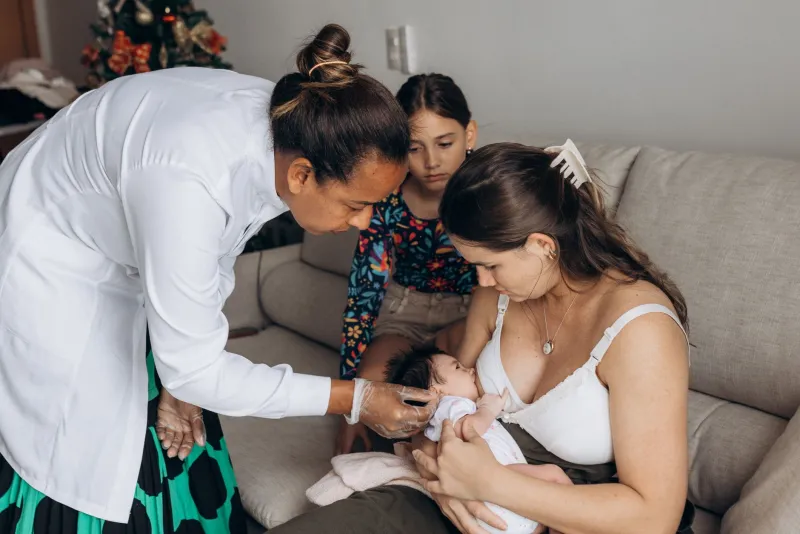
The Wild West of Lactation Support
Here's something nobody tells you when you're pregnant and scrolling through birth plans at 2 a.m.: the world of lactation support in the United States is wildly unregulated. Someone can call themselves a "lactation specialist," print a business card, and charge you $150 an hour — all without a single accredited credential to their name. Meanwhile, a board-certified lactation consultant might be available through your hospital at little to no cost, and you had no idea.
This isn't meant to scare you. It's meant to arm you. Because once you understand who actually has the training to help you and where to look, finding quality support gets a whole lot less overwhelming.
Breaking Down the Credential Alphabet Soup
Let's start with the gold standard. An IBCLC — International Board Certified Lactation Consultant — is the most rigorously trained professional in this space. To earn that credential, they've completed thousands of hours of clinical experience, passed a comprehensive exam administered by the International Board of Lactation Consultant Examiners, and must recertify every five years. These are the folks you want when things get complicated: latch issues, low supply concerns, tongue tie assessments, nursing after breast surgery.
Then there are CLCs (Certified Lactation Counselors) and CBEs (Certified Breastfeeding Educators). These certifications require less training than an IBCLC, but that doesn't mean they're useless — many CLCs are wonderful for general support, encouragement, and helping you troubleshoot early on. Think of them as a knowledgeable guide versus a specialist.
Finally, there are peer counselors — often moms who've breastfed themselves and received some structured training through programs like WIC or La Leche League. They're a genuinely valuable resource for community support and basic guidance, but they aren't a substitute for clinical care when something's wrong.
The bottom line? Ask anyone offering lactation support what their credentials are. A good helper won't be offended. They'll be glad you asked.
What Your Insurance Should Be Covering (But Maybe Isn't)
Here's a fact that doesn't get nearly enough airtime: under the Affordable Care Act, most insurance plans are required to cover lactation support and counseling. That means your IBCLC visits could cost you nothing — or very close to it.
The catch? "Required to cover" and "easy to access" are not the same thing in American healthcare. Some plans cover visits only in a hospital or clinical setting. Others require a physician referral. A few will reimburse you after the fact if you pay out of pocket and submit a claim. The specifics vary enormously by plan.
Here's what to do: Call the member services number on your insurance card and ask these specific questions:
- Does my plan cover lactation counseling with an IBCLC?
- Does the provider need to be in-network?
- Is a referral required?
- Are telehealth lactation visits covered?
Write down the name of the rep you spoke with and the date. If they say you're covered and you later get a surprise bill, that documentation matters.
If you're on Medicaid, coverage varies by state — but many states do cover lactation support, and more are expanding access. Your state's Medicaid office or a local WIC office can help you figure out what's available to you.
Don't Sleep on Free and Low-Cost Options
Even if insurance is a headache, affordable support exists. You just have to know where to look.
WIC (Women, Infants, and Children): If you're income-eligible, WIC is one of the most underutilized breastfeeding resources in the country. WIC provides peer counselors, some locations have IBCLCs on staff, and they can connect you with breast pumps and supplies. Find your local WIC office at wic.fns.usda.gov.
La Leche League: This volunteer-led organization has been supporting nursing mothers since 1956. Local group meetings are free, and their Leaders — trained (though not clinically certified) volunteers — can offer real-time support and connect you with professional resources when needed. Find a group at llli.org.
Hospital lactation programs: Many hospitals offer free or low-cost breastfeeding clinics, even if you didn't deliver there. Call your nearest hospital's maternity or women's health department and ask.
Community health centers: Federally Qualified Health Centers (FQHCs) operate on sliding-scale fees and often have lactation support available. Find one near you at findahealthcenter.hrsa.gov.
The Rise of Telehealth Lactation Consults
One genuinely good development in recent years? Telehealth has made it dramatically easier to access an IBCLC without leaving your couch — which, when you have a newborn attached to you, is not a small thing.
Platforms like Pacify, Mahmee, and Nest Collaborative connect you with IBCLCs via video call, often with same-day availability. Some are covered by insurance; others charge a flat fee that's still far less than a home visit. If you're dealing with something visual — like checking latch or assessing positioning — a video call works surprisingly well.
Telehealth won't replace an in-person visit for things like a physical tongue tie evaluation, but for the vast majority of breastfeeding questions and concerns? It's a legitimate, accessible option.
Pooling Resources: The Community Approach
Here's something creative that's catching on in parenting communities across the country: group lactation consults. Some IBCLCs offer small-group sessions — either in person or virtually — where several mothers attend together and share the cost. You get professional guidance, you get community, and you pay a fraction of what a solo visit would run.
Ask your IBCLC if they offer this format. If they don't, ask if they'd be open to it — you might be surprised. Some new parent groups and birth centers also organize these informally.
Mom Facebook groups and neighborhood apps like Nextdoor are also worth checking. Other mothers in your area have almost certainly navigated this before you, and they'll often share who helped them, what it cost, and how they got insurance to pay for it.
You Deserve Real Help
The fragmentation of lactation support in the US is a genuine systemic problem — but it doesn't have to stop you from getting the help you need. Knowing the difference between a certified expert and someone who just loves breastfeeding, understanding your insurance rights, and tapping into the free resources that already exist can make an enormous difference.
You don't have to figure this out alone, and you definitely don't have to pay out of pocket when you have options. Advocate for yourself, ask the hard questions, and know that quality support — the kind that's actually trained and accountable — is within reach.