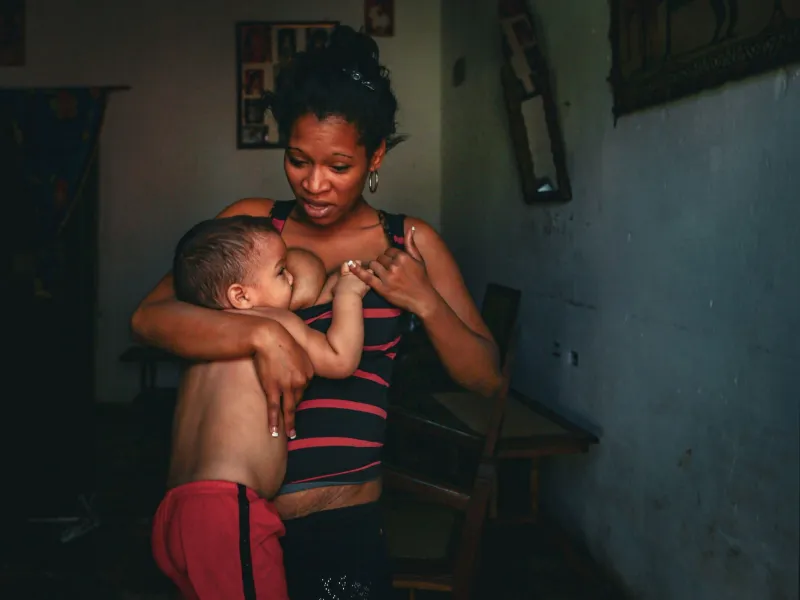
Still Nursing and Already Pregnant: The Honest Truth About Breastfeeding Through a New Pregnancy

Photo: Unknown, CC BY 4.0, via Wikimedia Commons
You peed on the stick. Maybe you were trying, maybe you weren't. Either way, you're staring at two lines while your toddler is literally latched on, and your first thought might be something like: wait, can I even keep doing this?
The short answer is: probably yes. The longer answer involves nipple sensitivity that will make you grip the armrest of the couch, milk that's going to taste completely different, a supply that may drop whether you want it to or not, and feelings so complicated they don't have a name yet.
Let's talk about all of it.
Your Nipples Are About to Have Opinions
If you thought newborn latch pain was intense, nursing during the first trimester of pregnancy introduces a whole new category of discomfort. Nipple sensitivity spikes dramatically in early pregnancy due to hormonal changes — specifically rising estrogen and progesterone — and for many mothers, nursing goes from a comfortable, connected experience to something that makes your toes curl.
Some women describe it as a crawling, almost aversive sensation. Others say it's sharp and burning, especially during letdown. This is real, it's common, and it doesn't mean something is wrong with you or your latch.
What can help: setting time limits on nursing sessions, using distraction techniques (books, songs, snacks), and being honest with yourself about your tolerance. Some mothers find the sensitivity eases after the first trimester. Others don't. Both outcomes are normal.
Your Milk Will Change — And Your Nursling Will Notice
Around the middle of the second trimester, your milk will transition back to colostrum in preparation for your new baby. This is a normal, automatic process. Your body is doing exactly what it's supposed to do.
For your current nursling, this means a few things. The volume of milk will decrease — sometimes significantly. The taste will shift, becoming saltier and less sweet than mature milk. Some toddlers take this in stride. Others protest loudly. Some self-wean entirely during pregnancy, which can bring its own complicated mix of relief and grief.
If your child is under 12 months when you become pregnant, the supply change is worth discussing with your pediatrician. An infant who's still primarily dependent on breastmilk for nutrition will need a plan for supplementation if your supply drops substantially.
Is It Safe? What You Actually Need to Know
This is probably the question you Googled first, so let's address it directly.
For most healthy pregnancies, continuing to breastfeed is considered safe. The nipple stimulation involved in nursing does release small amounts of oxytocin, which also causes uterine contractions — this is the concern that most often gets raised. However, current evidence suggests that for low-risk pregnancies, this level of oxytocin is not sufficient to trigger preterm labor.
That said, if you have a history of preterm birth, have been told you're at risk for preterm labor, have experienced any bleeding, or have been placed on pelvic rest, you should have a direct conversation with your OB or midwife before continuing to nurse. This is one of those situations where your specific medical history genuinely matters.
For the majority of mothers with uncomplicated pregnancies, the American College of Obstetricians and Gynecologists does not list breastfeeding as a contraindication. But don't just take our word for it — loop in your provider.
The Emotional Whiplash Is Real
Here's what the clinical literature doesn't really capture: nursing while pregnant can feel deeply strange emotionally, in ways that are hard to articulate.
You might feel touched out in a way that's more intense than anything you experienced postpartum. You might feel resentful toward your nursling for needing something from your body that feels like it has nothing left to give. You might feel guilty for feeling resentful. You might grieve the easy, uncomplicated nursing relationship you had before.
Nursing aversion — a phenomenon where breastfeeding triggers feelings of irritation, anxiety, or even rage — is more common during pregnancy than many people realize. It's not a character flaw. It's a physiological and psychological response that many mothers experience, and naming it can be the first step toward managing it.
Some strategies that help: shortening session lengths, setting gentle but firm limits with older nurslings, building in time to decompress after nursing, and finding a community of mothers who've been through the same thing. Online groups specifically for tandem nursing and nursing-through-pregnancy can be genuinely lifesaving for the "am I the only one who feels this way" moments.
Preparing for What Comes After: Tandem Nursing
If you choose to continue nursing through your pregnancy, you'll likely be tandem feeding — nursing both your newborn and your older child — after your baby arrives. This is worth thinking about before you're in the thick of it.
A few things to know:
Your colostrum belongs to your newborn first. In those early days, it's important to prioritize your new baby's access to colostrum. If you're tandem feeding, nurse the newborn first, then your older child.
Your milk will come in for the new baby. Once your milk comes in, supply typically increases again, and many older nurslings who had slowed down during pregnancy will ramp back up enthusiastically. Be ready for that.
You will need to eat and drink more than you think. Producing milk for two humans is calorically demanding. Take this seriously. This is not the time for restriction.
It's okay to set limits. You are allowed to create boundaries around nursing your older child, including limiting times, locations, and duration. This is sustainable parenting, not failure.
You Get to Change Your Mind
Maybe you started this pregnancy planning to nurse through it, and somewhere in the second trimester you realize you just can't anymore. Or maybe you were certain you'd wean before the baby came and now you can't bear to take that away from your toddler.
Both of those things are okay. The goal was never to hit a specific milestone. The goal is a feeding relationship that works for your family — and that includes your physical and emotional wellbeing, not just your child's.
Whatever you decide, you're not failing anyone. You're navigating something genuinely hard with care and intention. That's exactly what good mothers do.