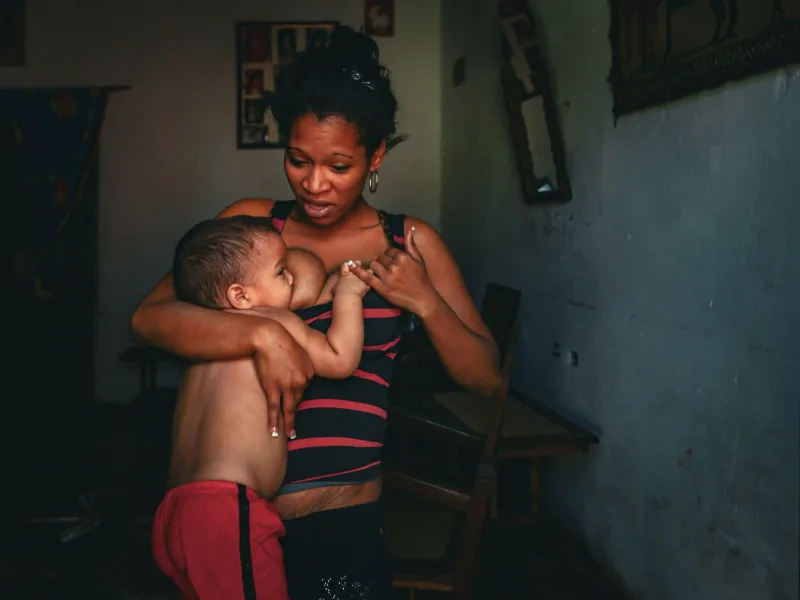
You Stopped Nursing — You Didn't Stop Being Her Mom

Somewhere between the last nursing session and the first morning you realized you didn't need to reach for a nursing bra, something shifted. Maybe you cried. Maybe you felt relieved and then felt terrible about feeling relieved. Maybe you scrolled Instagram at 2 a.m. looking at photos of other moms still nursing toddlers and wondered what was wrong with you.
Nothing is wrong with you. But let's talk about what's actually happening — because the emotional aftermath of weaning doesn't get nearly enough airtime, and too many mothers are sitting alone in that weird, heavy in-between space without any map.
The Part Nobody Prepares You For
We spend a lot of energy preparing moms to start breastfeeding. Classes, consultants, nipple cream by the case. But the end of nursing? It's treated like a footnote. A logistics problem. Cabbage leaves and sports bras and moving on.
Except your body and your brain didn't get that memo.
Weaning triggers real, measurable hormonal changes. Prolactin — the hormone responsible for milk production — drops. Oxytocin, which flooded your system every time your baby latched, pulls back. These aren't just numbers on a lab panel. They're the chemistry behind your sense of calm, connection, and emotional regulation. When they shift, your mood shifts with them. For some mothers, this looks like a few weepy days. For others, it looks a lot like postpartum depression — anxiety, irritability, a low-grade sadness that doesn't make obvious sense.
There's even a clinical name for the more intense version: D-MER, or Dysphoric Milk Ejection Reflex, though that typically occurs during nursing. The broader hormonal disruption of weaning is less formally categorized but just as real. If you're feeling off in the weeks after stopping, that's not weakness. That's biology.
When Guilt Shows Up Uninvited
Here's where it gets complicated: even when weaning is 100% your choice — when you're ready, when your baby is ready, when every practical reason lines up — guilt has a way of crashing the party anyway.
American culture has done a number on breastfeeding mothers. We've been handed this deeply loaded message that nursing is the gold standard of maternal devotion, and by extension, that stopping somehow signals a withdrawal of that devotion. The 'breast is best' campaign, however well-intentioned, accidentally created a framework where formula is failure and weaning is abandonment. That framing is wrong, but it's sticky. It gets into your head even when your logical brain knows better.
So you stop nursing and some part of you starts doing the math: Does this mean I love her less? Did I give up too soon? Will she remember this? (For the record: she won't. And it doesn't. And you didn't.)
The guilt trap is the belief that your value as a mother lives in your body's ability to produce and deliver milk. It doesn't. It never did.
The Identity Piece Is Real and Underrated
For months — sometimes years — breastfeeding structured your days, your wardrobe, your social plans, your relationship with your own body. It was a role you inhabited constantly. And then it ends.
That kind of transition carries grief even when it's welcome. Grief isn't reserved for losses you didn't want. You can grieve a chapter closing while simultaneously being glad it closed. Both things are true.
Some mothers describe feeling untethered after weaning, like they've lost a clear job description. Others feel strangely invisible — no longer visibly needed in that specific, physical way. A few feel a kind of liberation that immediately gets tangled up in guilt because liberation isn't supposed to be what you feel about your child.
All of these responses are normal. What's not normal is the silence around them.
Practical Ways to Move Through the Transition
Processing the end of nursing doesn't require a therapist's couch (though there's zero shame in that option — more on that in a second). There are smaller, more immediate things you can do.
Name what you're feeling. It sounds almost too simple, but labeling your emotions — "I'm grieving," "I feel guilty," "I'm relieved and that's uncomfortable" — actually reduces their intensity. Don't just push through. Acknowledge the thing.
Give yourself a physical transition ritual. Some mothers find it helpful to do something intentional to mark the end of nursing — a journal entry, a photo, a small ceremony that says this mattered, and now it's complete. You don't have to pretend it was nothing just because it's over.
Watch for the hormonal dip. If you're feeling persistently low, anxious, or disconnected in the weeks after weaning, talk to your OB or midwife. Weaning-related mood changes are real and treatable. Don't white-knuckle through something that has clinical support available.
Reconnect with your body on your own terms. For a long time, your body belonged — in a very real, physical sense — to feeding your baby. Now it's yours again. That can feel strange. Let yourself ease back into that ownership without pressure.
Find your people. Whether that's a postpartum support group, an online community, or a single friend who gets it, talking to other mothers who've been through weaning helps. The isolation of thinking you're the only one who felt this way is its own kind of weight.
A Note on Therapy and Professional Support
If the guilt and grief aren't lifting, or if they're interfering with your daily life or your relationship with your baby, please reach out to a mental health professional who has experience with perinatal mood disorders. Postpartum anxiety and depression don't always show up right after birth — they can surface during weaning, during the return of your period, during sleep training, during any major transition in the early years. You're not overreacting. You're not being dramatic. You deserve support beyond "just give it time."
The Bottom Line
You are a mother every single hour of every single day — not just during the hours you spent nursing. Your worth, your bond, your presence in your child's life was never actually located in your breast tissue. It was always in you.
Weaning is a transition, not an ending. And transitions are allowed to be hard, even when they're right.
You made a decision for your family. That's what mothers do.